It has taken me a while to process everything I saw, felt, and heard the weekend that Andy and Cari Larsen spent with us at Winnetka Covenant Church. In fact, I’m still processing it.
I confess that I knew less about the situation in the Middle East than I should. What I thought I knew was blown out of the water when we watched the movie “Where Olive Trees Weep” on Friday night. By the time it was over tears were freely running down my cheeks. Listening to the first-person accounts from people on both sides who live there, and watching the contrasting images I was viewing on the screen literally made my heart ache.
It matters which side you are on, and whichever side you are on, it matters that you allow time to take a long view of the conflict. It also matters that you understand what is happening in the present. Whichever side you are on, it matters.
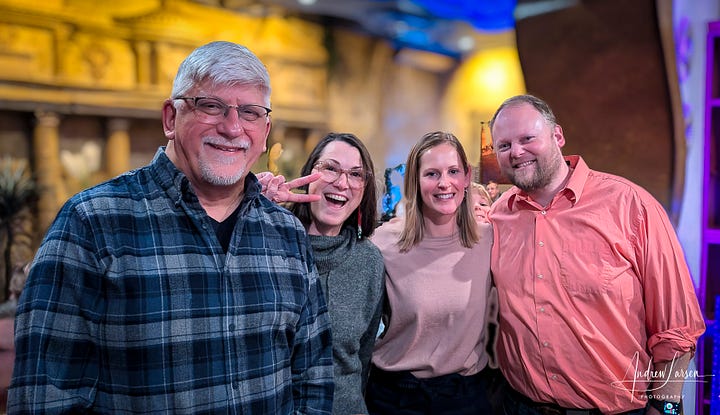
On Saturday we went to dinner at Al-Bawadi, a Palestinian restaurant, and I was struck by three things. First was the incredible feast of food presented to us, most unknown to me. Second, the birthday celebration going on at the next table to ours. Third was how poignant and honest the stories of the people who spoke to us felt; the son of the owner, and our waitress Rose.
And this is what struck me. The fabulous presentation and abundance of food was unique to the culture of the restaurant, but not unique in the fact that the same presentation and abundance could happen at any one of the many ethnic restaurants we happily enjoy living in this area. Second, the birthday celebration was like many others I’ve witnessed at restaurants…people happily singing and clapping with sparklers adorning the dessert to be shared by the birthday girl as many others in the restaurant joined in the singing. Third, the immigration stories that were told to us shared many experiences told by other immigrants to our country…including me. I arrived in the United States at age fifteen and ultimately became a citizen like they did. HOWEVER…
There was one GREAT difference! My immigration story did not contain bloodshed. I did not see family members killed in front of my eyes. I did not come to this country because my home was taken away from me or burned to the ground. I did not fear for my life as I made my way to the United States. I did not have to learn a new language or blend into a culture when physically, it was obvious that I did not. I hadn’t left everything behind. I did not have to begin a new life from the ground up, always fearing I was unwanted in my neighborhood.
I repeat. It matters which side you are on, and whichever side you are on, it matters that you allow time to take a long view of the conflict. It also matters that you understand what is happening in the present.
If you would like to see the documentary, “Where Olive Trees Weep,” it is available on YouTube. It is worth investing your time…no matter which side you are on.
The light shines in the darkness, and the darkness did not overcome it. (John 1:5)
I realize in these dark and cold winter days that I’m searching for ways to make light. Here in my office the fragrances of pine trees and cinnamon wrestle for dominance thanks to the candles that I light. On my windowsill an electric candelabra shines five-strong for the world to see. My normal, rather dim desk light, usually the only one switched on, is joined by a choir of three others from different corners of the room. At home, I find myself thoroughly excited to replace old batteries so that the fake but real-looking birch bark candles can give a warm glow in the dark. I am comforted even to leave them on through the night.
Light — glowing, bright, flickering — fills me with hope, reminds me that all is well. This is a thoroughly biblical idea, culminating for St. John in Jesus, who is proclaimed to be the light of the world, the One who overcomes all the darkness everywhere. “The true light, which enlightens everyone, was coming into the world.” (1:9)
The news is that in Jesus’ coming — in his life, death, and resurrection — the darkness has been defeated by the light. The darkness did not, is not now, and will not win. And that is the hope of our faith we might hold onto through these days, through all of life’s experiences, both personal and way out beyond our control.
So light a candle, or “turn one on” as we say these days, and watch the darkness scatter, and rest in God’s promises.
“But seek first the Kingdom of God and his righteousness, and all these things will be given to you as well.” (Matthew 6:33)
The comment came my way again this week: “Pastors should not reveal their political views in one direction or another.” I’ve always wondered about that, and have on occasion asked a question back: “Where did you get that idea?” I get the comment and the feeling behind it, that sharing honest feelings about political things can quickly upset the apple cart. It often strains relationships, and can be received as a dismissive comment to someone who feels differently. And, of course, social media seems to encourage the ginning up of things.
But here’s the thing. As followers of Jesus, we simply have no choice but to care deeply about, comment on, and advocate for a just a right world, and this requires of us that we speak up when something’s not right or just or merciful. Further, as human beings we all feel deeply and differently about many political things, and it’s only a false peace if we don’t work on our differences together.
Consider that the word “politics” means “Things of the city”. While the word these days causes our blood pressure to soar, its basic meaning is to care about the basic realities of life for us, and according to Jesus, for our neighbors just as much.
These days I’m all worked up about the order of things, and feel we as Christian community are in need of a collective repentance for our preoccupation with our national leadership and political scene while we are neglecting what is to be our first love, and true preoccupation, the Kingdom Of God and Jesus Christ who embodies it. Jesus cares deeply about “the things of the city”. So too must we. And our much needed reformation is to turn down the news, seek first God’s Kingdom, and then come back to the news with a unified sense of God’s values and hopes for our world. Yes, I said unified! Because if we can’t come to some common, shared values we are speaking and working for — if we don’t start from that place — then we have failed in our call to follow Jesus.
All this to say that we are called to be deeply involved in politics, in the things of the city, but our view about the the things of the city are to be shaped NOT by the ongoing human quests of empire for power, wealth, and influence, but by the Kingdom of God values of compassion, justice, and what is best for us all, and especially for the vulnerable. Notice how different the values of these colliding kingdoms are.
I am convinced that this is our next lengthy journey together as a community joined together in Christ, to go back to the scripture, and to sit with the Spirit, and to work and pray together to figure out the common values we share that align us with God’s plans for the world. Then, and only then can we start to talk about the differences we have in a healthy way.
To answer personally, I feel that God’s call on my life as a Christ follower and as a pastor requires that I seek constantly to discern with the help of Word and Spirit what the Kingdom of God has to say to the world we live in, and the way it is living. That’s the job of a preacher and teacher. I am well aware that sometimes, maybe more times than not, I get it self-centeredly wrong. When you feel this happens, let’s talk about it! It is also the case, at times, that we just don’t like what Jesus has to say to us, because he is always calling us out of our self-preoccupation and into the service and care of others. Literally, he lays down his life, and calls us to do the same. We pray every week “May your Kingdom come, and your will be done on earth as it is in heaven.” It’s time for us as Christians in America to give our time and attention, and so our hearts to the seeking of God’s Kingdom. This is where our hopes for the world lie. This is where we find our political platform.
Look for an opportunity in time to come to join a cohort of friends with the goal of forming a common politic rooted in an understanding of God’s Kingdom priorities, with shared values that we can affirm together, and from which we seek to engage the world around us.
Before ever we are democrats, republicans, or independents, we are people of faith, Christian in particular, followers of Christ. If this becomes our core identity, then a more just and right world will take shape as we speak and act.
In conclusion then, a pastor (and every christian) must speak and act out their politics. May those come from partiality to the Kingdom of God.
Today’s blog post is reposted with permission from Andrew Larsen and Cari Conklin-Larsen’s substack, Blessed Are the Peacemakers.It is a reflection on their visit with WCC that concluded on January 26.
Andy and Cari are in particular need of financial support to continue their ministry; subscriptions help, and individual gifts are always welcome too.
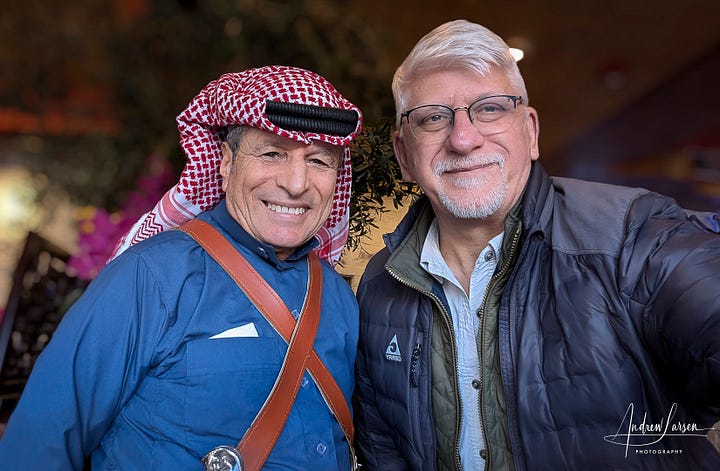
A Palestinian restaurant buzzing with conversation. An upper room in the church building, where we gathered to unpack what we’d just seen on screen. The hush of a mosque as the call to prayer echoed off the walls. A weekend filled with hospitality, hard questions, and the kind of shared laughter that carried us through every encounter. The contrast was striking, and at times, I found myself deeply grateful—not just for the warmth of our hosts but for something far less profound: the heated seats in our rental car. But that small comfort felt fleeting when I thought about those whose journeys aren’t cushioned by privilege, like Lind, a four-year-old girl killed in Gaza when her family’s car was pummeled by multiple rounds from a tank—a cruel and brutal act in the ongoing genocide. This was our weekend in Winnetka. A weekend of peacemaking. A weekend of discovering what happens when we step beyond what feels familiar and into unexpected relationships.
From Fear to Friendship: The Heart of Peacemaking
What does it take to move from fear to friendship? How do we learn to see those we’ve been conditioned to distrust as neighbors instead of enemies? What happens when we step outside our comfort zones and into unfamiliar territory? In a world that thrives on division, we believe that peacemaking is not just an idea—it’s an intentional practice of showing up, listening, and crossing boundaries.
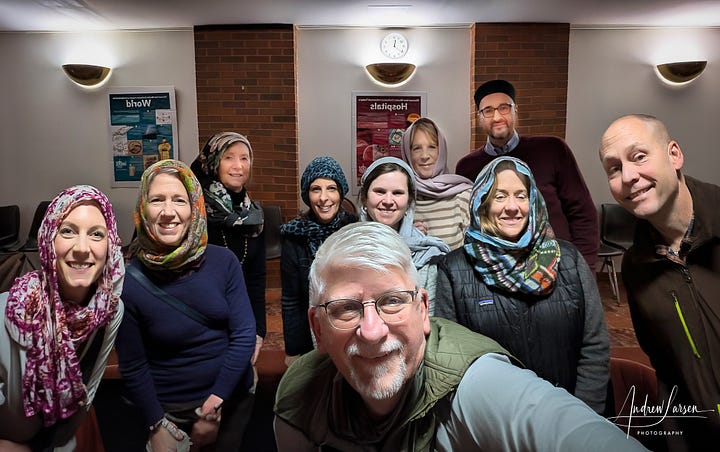
Last weekend in Winnetka, we gathered with a church community that was eager to deepen their commitment to peacemaking. Their presence was steady throughout our three-day journey—showing up for meals, engaging in difficult but necessary conversations, and bearing witness to stories they hadn’t heard before. Cari and I had the privilege of walking alongside this community as we explored what peace might look like—not just in the Middle East, but in our own neighborhoods, families, and in the interfaith and peacemaking work that calls us forward.
We opened our Bibles and wrestled with some of the heavy challenges in our world today. We talked about Gaza. And Israel. And our own theological blind spots. As one participant put it, the film “made us all raw,” creating space for honest reflection and deep engagement.
Snow Dunes and Frozen Shores: A Different Kind of Pilgrimage
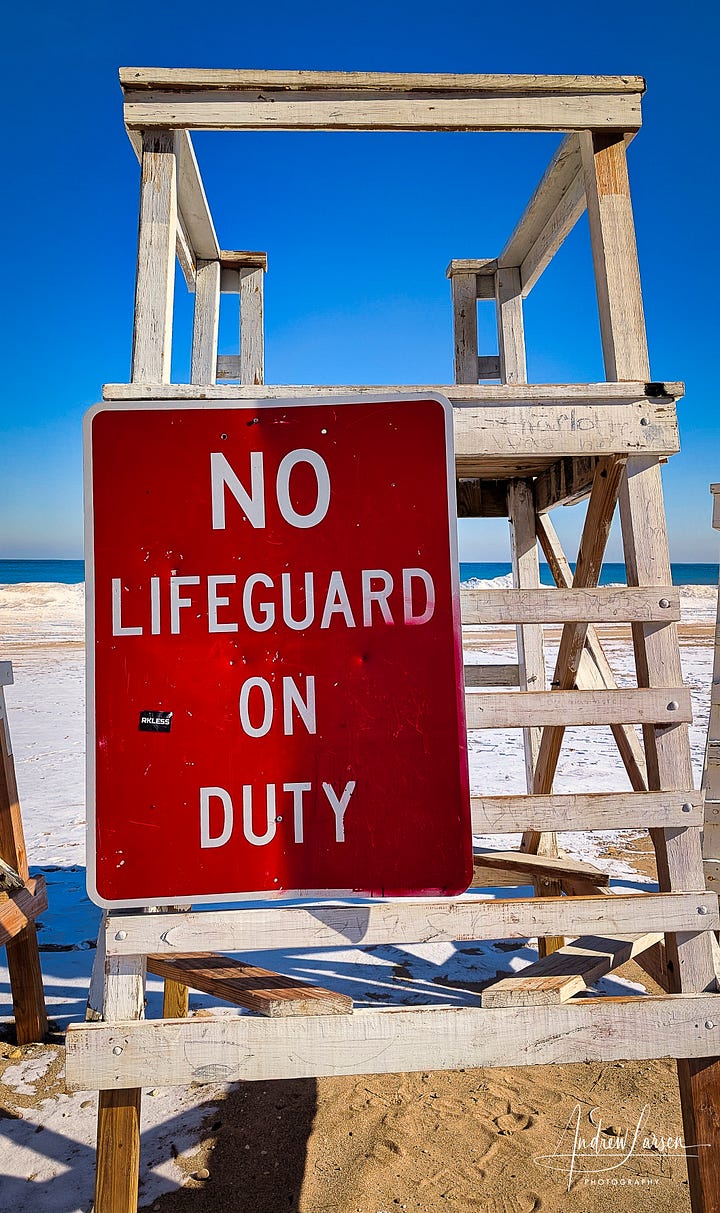
That first morning, we awoke to 4-degree temperatures and frozen ground along Lake Michigan. Our Airbnb stay in a classic Lustron home, an all-metal post-war prefab, added a quirky charm to the weekend—like living inside a time capsule from the 1950s, complete with sleek metal walls and a mid-century vibe. And outside, as we drove along Sheridan Drive near the Point Gross Lighthouse, I marveled at what I could only describe as “snow dunes”—rolling waves of white, sculpted by the wind and freezing temperatures, forming a surreal landscape where sand met ice. It was as if the very spot where sunbathers usually lounge in the summer had transformed into a frozen desert overnight—waves of snow and ice replacing the warmth of sand and sun. Not that lifeguards would have been much help—unless they had ice picks and thermal gear.
Friday: Stepping Into Sacred Spaces—Mosque Visit, Film Screening, and Raw Reflection
We kicked off the weekend with a visit to a mosque during midday prayers, where we listened to a sermon (khutbah) in Bosniac, Arabic, and English before observing the prayers of our Muslim brothers and sisters. For most in our group, it was a first-time experience, and the warmth of the Imam’s hospitality and his openness to our questions underscored how simple gestures of welcome can dissolve barriers and foster understanding. As I sat there, I also wondered—was anyone in the mosque afraid of ICE, or what the new administration might do to their community? We left feeling both grateful and inspired, having glimpsed a deeper sense of shared humanity—like Chris Martin of Coldplay sings, “and you could be my brother, not my enemy.”
“What in the world are we going to do? Look at what everybody’s going through.” — Coldplay, Everyday Life
That evening we watched Where Olive Trees Weep, a film that exposed the harsh realities of Gaza and Palestine, leaving many of us deeply moved. As the final credits rolled, the room sat in silence. Some wiped their eyes. Others stared ahead, still processing. One person finally spoke to me personally: ‘I just… I had no idea. How have we not heard these stories before?’ The weight of that realization hung in the air. That question lingered throughout the weekend, surfacing in conversations about justice, theology, and our responsibility as people of faith. The film had done what no news segment or statistic could—it had broken open hearts. Brian Madvig, a therapist and former seminary peer, helped us process the vicarious trauma we felt on Friday night. Then on Sunday, after the sermon, as we chatted in the church foyer, he reflected further, saying, “You took us to a place we should go to! It was disturbing but necessary.” His words reminded us of the vital importance of sitting with discomfort and bearing witness to truths that demand attention.
Saturday: From a Winnetka Breakfast to an Iraqi Pilgrimage—Peace Feast, Hard Questions, and Building Bridges
Saturday’s highlight was the Peace Feast at Al Bawadi restaurant in Niles, where over 35 people gathered to share a meal and engage in meaningful conversations. Earlier that morning, I had the chance to speak at a men’s breakfast, where I shared about my journey to Iraq and the profound experience of visiting Ayatollah Sistani with a group of Shia pilgrims. Recalling the 120-degree heat of Najaf while bracing against Chicago’s subzero temperatures was surreal. But beyond the physical contrast, something deeper struck me—how stepping into unfamiliar places, whether in the sweltering deserts of Iraq or the quiet halls of a Midwest mosque, opens up the same unexpected possibilities for connection and transformation. Over plates of hummus and grilled meats in the evening, we pondered what it means to ‘make hummus, not walls’—a phrase that echoes Banksy’s graffiti in Bethlehem and speaks to the deeper call of peacemaking.
Sunday: The Surprise That Turned to Resistance—Luke 4 and the Call to Peacemaking
On Sunday morning, I preached on Luke 4:16-21, where Jesus unrolls the scroll of Isaiah and proclaims good news to the poor, freedom for the captives, and the year of the Lord’s favor. At first, the crowd in his hometown synagogue was captivated. But then came the surprise—what Jesus chose to leave out. He stops short of the expected ending—omitting the part about the ‘day of vengeance of our God.’ By doing so, Jesus reinterprets Isaiah’s words, reframing God’s mission not as retribution but as liberation and healing for all people.
At first, they marveled at his words. But their admiration quickly turned to outrage. How could God’s mercy extend beyond their tribe? How could their exclusive hope be shared with outsiders? Their resistance built quickly, mirroring the way we, too, resist when love demands more of us than we expected—when it calls us beyond borders, beyond comfort, beyond the narratives that justify oppression. What happened that day in Nazareth still happens today.
The Bigger Picture: Peacemaking, Truth, and Discipleship
Throughout the weekend, we sought to center peacemaking as an essential part of Christian discipleship—not an add-on or extracurricular activity for specialists like me. Peacemaking is more than just reconciliation; it requires a commitment to truth—truth about our own histories, about the injustices that shape our world, and about the ‘others’ we have been conditioned to fear. Peacemaking cannot be reduced to a personal or internal pursuit alone; it must be embodied in how we engage with the world around us.
“The word peace appears 100 times in the New Testament, but theologians…often limit it to individual reconciliation with God—without significant attention to God’s work to reconcile us with others or with enemies… They often reduce it to inner peace, or peace with God, without attention to God’s will for peace among God’s creatures.” — Glenn Stassen
A Benediction and Charge for Action
At the end of my sermon, I offered this benediction and charge:
“May the Lord bless you and keep you; may the Lord make his face shine upon you and be gracious to you; may the Lord lift up his countenance upon you and give you peace.”
But I also challenged the congregation: “don’t stop there. Go out and give this blessing to someone outside your cultural, political, or religious circle. Look someone in the eye who you’ve been taught to fear, avoid, or misunderstand, and speak peace over them. Let them know that God’s face shines upon them, too. Because the kingdom of Jesus doesn’t have fences, and his love never stops at a gate.”
If God’s love knows no boundaries, then we, as followers of Jesus, should also refuse to be constrained by human-made divisions—whether cultural, political, or religious.
This wasn’t just a weekend—it was a glimpse of what’s possible. When people sit together, break bread, and share their lives, something shifts. Walls come down. Stories change us. But the work isn’t finished. Peacemaking doesn’t belong to a select few—it belongs to all of us. Where might you step in? A conversation? A shared meal? A moment of courage to cross a boundary? Because the world doesn’t just need peacekeepers or peace talkers. It needs peacemakers. Let’s keep going—together. If this work speaks to you, share it, join the conversation, and step into peacemaking wherever you are.
Join Us
We invite you to support our work in one of these ways:
Subscribe to our Substack: Stories, reflections, and resources for peacemaking.
Direct support: Partner with us through Peace Catalyst International. Learn more here.
Purchase photos and merch: Explore photography and merchandise on my website.
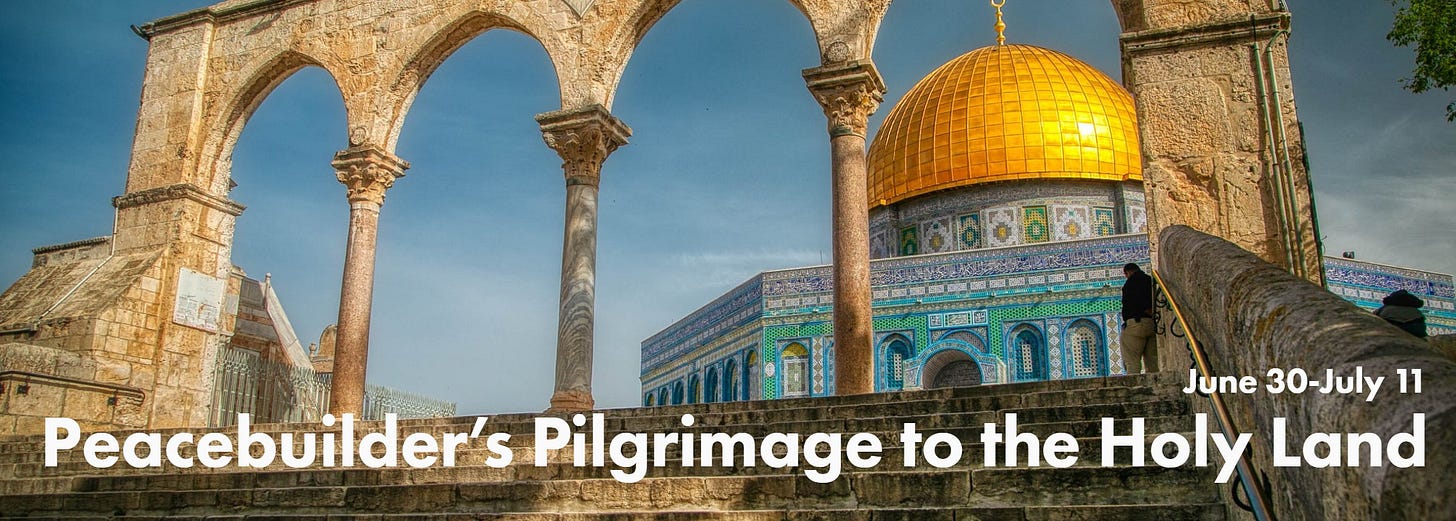
Finally, consider joining our solidarity tour to Palestine-Israel this summer. See our work firsthand and experience the heart of peacemaking: Holy Land Pilgrimage.
Peacemaking begins with proximity, courage, and love. Join us—through subscribing, supporting, or traveling—and let’s create spaces of healing, hope, and courageous love, near and far.
“Blessed are the poor in spirit, for theirs is the kingdom of heaven.
Blessed are those who mourn for they will be comforted. Blessed are the meek, for they will inherit the earth. Blessed are those who hunger and thirst for righteousness, for they will be filled.
Blessed are themerciful, for they will be shown mercy.
Blessed are the pure in heart, for they will see God. Blessed are the peacemakers, for they will be called children of God.
Blessed are those who are persecuted because of righteousness, for theirs is the kingdom of heaven.
Blessed are you when people insult you, persecute you and falsely say all kinds of evil against you because of me.
Rejoice and be glad, because great is your reward in heaven, for in the same way they persecuted the prophets who were before you.” (Matthew 5
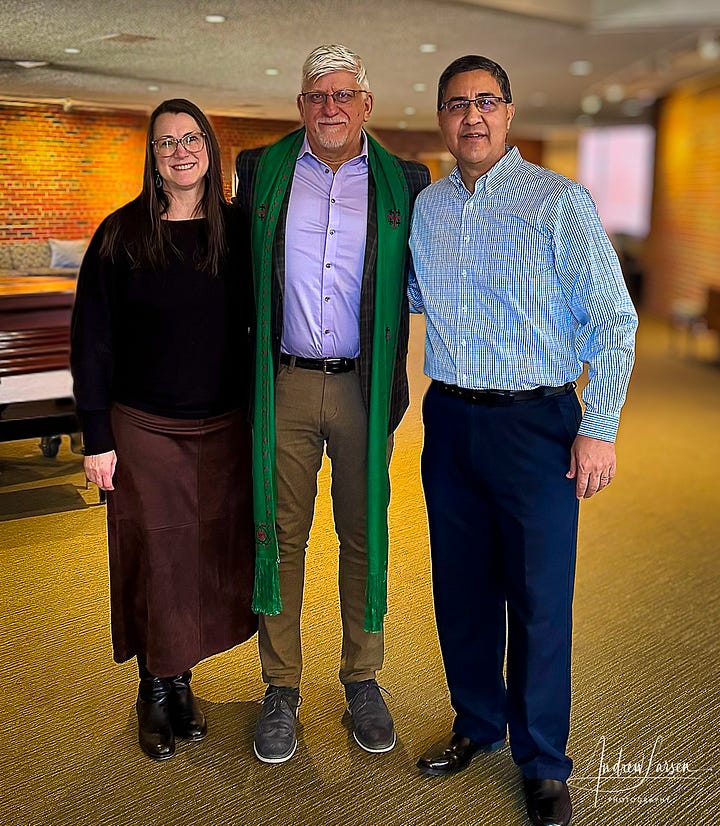
This weekend we had the wonderful privilege of being joined and led by Andy Larsen & Cari Conklin-Larsen, faithful Christ-followers and peacemakers. I was able to join in this weekend for the peace feast on Saturday night at Al Bawadi Grill, a Palestinian restaurant in Niles, and adult Sunday School the next morning. Throughout the weekend, I was struck by Cari & Andy’s leadership and their emphasis on story-telling– their own stories and those of others. On Sunday morning, they shared a little bit about how they both became engaged in this peace-making work, how it led them to one another, how it has led them to other dear friends, and how this work has become central to how they see the gospel and the call of God on their lives. What was so beautiful to me about all of this is that Andy & Cari, by their own admission, are simply normal followers of Jesus just like the rest of us. They haven’t been studying Middle East peace relations and politics their entire lives, they both simply responded to God’s Spirit and loving prompting to begin learning about and participating in experiences they previously didn’t know much about and to become proximate with people that are different from them. The Spirit has led them to become staunch advocates of peace-making, on the ground in Israel/Palestine and in congregations like ours, and has led them to do the important work that Christ called them to, that they weren’t necessarily equipped for prior.
What an important and beautiful reminder that every single one of us has this same Holy Spirit within us. Every single one of us is being lovingly called to something by our faithful God, I really do believe this. And it could be something as “simple” as peace-making or mercy. After all, through the Beatitudes, what Jesus is calling his followers to is not something any of us can master in a day, or a month, or even in years. Being merciful, being meek instead of proud, being pure in heart, hungering and thirsting for justice and righteousness, and being peace-makers are lifelong tasks that we can only do with God’s help.
Another follower of Christ that I’ve similarly been inspired by in recent days is Bishop Mariann Edgar Budde. She preached the homily at Washington National Cathedral during a prayer service for our country and for its unity. The link can be found here. Her message was so startlingly simple, which was why it was so beautiful. She reasons with all of us that in these divisive, scary, ever-changing days, if we are to be united we must unite around these things, which are of course also Christ’s way: the dignity of every person, truth-telling, and humility. In Bishop Budde’s words, I could almost hear Christ himself saying, “Blessed even are the poor in spirit, they too have dignity!” and “blessed even are the pure in heart, for they are upright and honest!” and “blessed even are the meek, for they are humble and gentle just as I am gentle and humble in heart!”. At the end of her homily, she then addressed President Trump, echoing Jesus’ words exactly this time, exhorting him towards mercy. This clip has since been widely circulated on the internet and social media, and it has made me glad that large swaths of people, people who rightly have reasons to be skeptical of the Church, are seeing and hearing what Christ’s followers are really called to, which is to, throughout our lives, become characterized more and more by the Beatitudes, by the way of Christ.
May we be inspired by great leaders like Bishop Mariann Edgar Budde and Rev Dr. Andy Larsen & Cari Conklin-Larsen, who embody and teach us about the way of Christ. But church, may we not stop there! May we know that the same Holy Spirit who has led these leaders to where they are, is within us and is calling us to something too. In these days of political division, conflict, and exhaustion, I really believe that God is still on the move and it is in the hearts and lives of people like you and like me. May we respond boldly to God’s call on our lives, to be peacemakers, to be merciful, to the people we encounter, in the places we go, in the things that we say, in the ways we spend our time, in the ways we spend our money, and more.
May you find encouragement from one more leader, who I think embodied the way of Christ also, the late President Jimmy Carter. He said: “I have one life and one chance to make it count for something… my faith demands that I do what I can, wherever I am, whenever I can, for as long as I can, with whatever I have, to make a difference.”
Blessed are you and blessed are the merciful and blessed are the peacemakers,
“And God has appointed in the church first apostles, second prophets, third teachers; then deeds of power, then gifts of healing, forms of assistance, forms of leadership, various kinds of tongues.” (1 Corinthians 12:28)
My guess is that if you were quizzed about spiritual gifts, your top answer would be the glitzy ones: preaching/teaching, leadership, healing, wisdom, discernment. Those are the ones I’d list. And I’m guessing one I wouldn’t readily remember to name is “forms of assistance” — helping, supporting. The evidence of this is found in a google search that might render 10,258 leadership or preaching conferences, and just a few when searching for “servanthood conferences.”
I wonder why this is? Why does this gift of power to serve, to help, go so unnoticed? It is, after all, maybe the most accessible for us, because it has to do not so much with an innate skill as a cultivated heart and the will to respond. I’d argue that for disciples growing in faith it’s the most common gift, at least in theory. No doubt it’s the most need in the church. We know this because the ask and opportunity is constant. Servants/helpers are needed to set up chairs, to take down chairs, to provide a meal, to donate coats, to serve as a leader, to give gifts, to read scripture, to pray, to show up, to make coffee…the list seems endless. But so are the possibilities for your “antilepsis” to come to life!
That’s the greek word, “antilepsis” — meaning literally “taking hold alongside” — and this along with the other greek word “diakonos” speaks to the engine that drives the ministry machine of the church, always and everywhere — serving, helping. the gift of ability to see/hear how help/support is needed by others and the willingness to provide that practical help. “Taking hold alongside” of some task that can bless another.
Currently in our bulletin announcements and Wednesday wire there are three practical opportunities that are not new, but have been sitting there for awhile:
1) We need ushers and scripture readers to greet us with joy, to read to us God’s Word, and to gather our offerings together. (winnetkacovenant.org, click on resources, and sign up).
2) We need children’s Sunday school teachers to love and serve our kids. (misseandkari@winnetkacovenant.org)
3) We need bus drivers to help get Covenant Living residents to church on Sunday mornings. (Contact church office, 847.446.4300).
We have been made duly aware of the practical needs — we see, we hear. The questions is, will we respond with a willingness to help, a practical “yes, i’m on it!”? Will our “antilepsis” nudge us to sign up, to say “yes”? Are we willing and able to meet these needs practically?
The promise is that as much as we commit ourselves, we’ll find ourselves blessed with a filled cup as we see and greet and serve others around us, as we find how simple it is to help practical things get accomplished for our kids, and seniors, and those who come to worship God. The key move is to see the constant ministry needs of the church as opportunities to serve and be blessed, and so as gifts after all!
In this constant process of offering ourselves we embody and share the love of Christ. The contemporary hymn (617 in blue hymnal says it so beautifully):
Will you let me be your servant, let me be as Christ to you? Pray that I might have the grace to let you be my servant too.
May this be our posture as we consider the practical needs before us. ANTILEPSIS!
Early last month, when I arrived back from sabbatical, I found a hum of excitement about what was going on….in Sunday School.
Sunday School, you might ask? Really?
Yes! Sunday School!
And not just because we had a wonderful assortment of guest speakers come in, although certainly that was some of the appeal, but because of one thing I heard over and over again: “we got to share our stories.”
Of course, I was thrilled to hear this. Thrilled to see people’s enthusiasm for a program that has waxed and waned especially since COVID, but above all thrilled to see them embrace what is a central part of our faith: telling and sharing stories.
As it happened, I had been thinking about this some during my sabbatical. I spent a weekend down in Alabama where two dear friends and seminary classmates of mine have pioneered something new with the help of a grant from the Lily Foundation. It’s called OptIN, and takes a totally different approach to Christian formation: discipleship as trade school.
Just like anyone who wants to become a carpenter, an electrician, a cosmetologist, or many other kinds of specialized careers needs to attend a trade school and learn certain skills, we too need some specific skills in our lives as Christ-followers. But where do we learn them?
Unfortunately, many models of Christian formation don’t teach us these skills. Skills like prayer, and worship, and telling our faith stories. And that’s where OptIN comes in. During my visit to my friends’ church, which is a sort of incubator for trying out these different materials and curricula, I got to watch their Sunday School class in the final sessions of the “Building Stories” unit. And it was incredible.
People who had known each other for decades, raised kids together, grown up alongside each other, learned new things about each other by listening to these short stories, no more than a few minutes each. Laughter and tears were both shared, people listened and reflected back on where they’d seen God in their friends’ and classmates’ stories, and a deep sense of something holy filled the room.
I, a stranger to most of them, sat in on their class and was deeply moved.
When I came back and heard that we had begun doing a little of this kind of sharing together, informally, on Sunday mornings, there was no doubt in my mind: it was time for us to try OptIN.
So I invite you, on Sunday mornings starting this week (February 2), to join us for our next study: Building Stories. This will carry us throughout February and into the first week or two of March.
We will begin by telling some simple stories together, getting comfortable sharing with the group, and then we will progress towards identifying some important faith stories in our lives and ultimately sharing those together.
This type of study works best when we all truly “Opt In,” so I ask you, as much as you can, to make the commitment for the next five weeks: to show up, to share, to listen. I am confident you’ll be glad you did.
“But as it is, God arranged the members in the body, each one of them, as he chose. If all were a single member, where would we be? As it is, there are many members, yet one body.” (1 Corinthians 12)
Last night in our ZOOM bible study, gathering as always with the dearest of friends, we read together St. Paul’s grand declaration of the Church as the Body of Christ, and his great reflection on body imagery. Some of us reflected on how we understand body issues as we grow older and find one or three body parts not working the way they have, or should. We shared our aches and pains.
Then, just then, Nita chimed in with a smile, as she does in a lovely way when she speaks. She shared that she’s had hearing struggles for most of her life that have left her almost deaf. But rather than simply being defeated by that, she told us that she has a friend who is blind, but has great ears to hear! And they have discovered the joy of going out to lunch together — which they couldn’t do each on their own — TOGETHER! “I pick her up, and at the table read the menu to her, and she orders the food for us!”
Herein lies a core reality of our human existence and what it means to be a spiritual community, indeed a spiritual body. We can do together what we cannot do alone…we need each other! And we HAVE each other, each of us fearfully and wonderfully made, and uniquely gifted with strengths that someone else in the community needs. We ALL are necessary!
Paul goes on to list all kinds of gifts and functions…prophets and teachers, those who rightly handle power and lead well, some whose very presence brings healing, those who help with servant hearts, those who have the gift of language that helps us find our words. It’s not an exhaustive list, but is meant to get us thinking, contemplating our own gift, and who it is that needs it, and how we can take the step Nita and her friend have made in helping each other to get out and fellowship.
Nita inspires me, and hopefully you as you read this. Our deficiencies don’t disqualify us! We don’t need to stay home and pack it in, but we have each other, and surely there is someone else in our community who has just the gift or strength I need to help me. And so also do I for someone else. And so God has formed us, knit us together.
I am left pondering these questions, and invite you to join me:
What is the gift/strength/aptitude that God has gifted me with? Who needs what I have to offer? How can I help the Body of Christ be healthy and strong?
Imaging Nita and her friend lunching together, and in full disclosure of the deficiencies each of us bear, can we be stubborn still to be enthralled at the thought of together how strong we are and what we can do? Thank God, thank God we are not alone, but have each other!
Nita, thanks for inspiring us through your actions.
“The days of our life are seventy years, or perhaps eighty, if we are strong; even then their span is toil and trouble; and they are soon gone, and we fly away…so teach us to count our days that we may gain a wise heart.” (Psalm 90)
On my walk with bear I find myself contemplating the passing of time. It’s stunning, and seems to move faster for those who grow old. It’s not true, of course. And it’s not surprising that this time of year brings me to it’s accounting, because it’s the new year, and because yesterday my own calendar clicked another one tenth of a score ahead.
As the snow crunches on the old path that use to be a railroad cut, I can’t believe it’s 2025 as I remember the days around Y2K. Remember how afraid everyone was that all computers were going to crash? I can’t believe that when Bon and the girls and I arrived to be with you I was 38 and now I am 61? What are your own “I can’t believe’s?”
It was forty years ago now that my grandfather Eric died and the sermon text was Psalm 90. It’s a sweeping, expansive epic about God’s eternity and human frailty, most acutely experienced in the passing of time. I remember that day being somewhat confused about the concept of time being a limited, fleeting thing. How predictable but naive of my twenty year old self! Yet here is sit, 40 years later, unable to fully comprehend where time has raced off too. Much more by now I appreciate, recognize, and humble my spirit in the news that in the grand scheme of things my days will soon be gone. Numbers don’t lie. I am living now my 27,250th day of life. According to the current life expectancy of an American white male (74.6), I have 4,984 days left. How’s that for counting my days! My aches and pains and pills say that it is so.
Now I’m not trying to be fatalistic, and I don’t think I’m sinking into depression, though I have my days! But I’m learning the power of “counting my days” — starting to see how very important this is for the process of living, of life. To be acutely aware that life is passing, to live with a deep sense that the passing of time is inescapable can gift us with wisdom. And this many-dimensioned wisdom is at least in part about being acutely aware that life and it’s time are gifts of the first order. “Time is the final currency” sings David Crosby, “not money, not power. The time will come when you will give anything for one more hour.”
I’m wondering if dealing with our own mortality becomes a fueling gift for the life we have now, presently, living the only day that is today. Learning to count my days — does that give me the impetus to linger and take in the sunset, or call up a loved one and make things right? Does it move me to make plans for adventures sooner rather than later, does it help me find the tender words I want to say while I can say them? How does the real truth that time is fleeting interface with the invitation of Jesus Christ, my Lord to love, and give, and serve so as to help the Kingdom of God come? What am I being called to do with the time I have yet still to live?
I am greatly comforted that “some great morning when this life is over I’ll fly away”…that resurrection is a real hope for us, immortality gifted to us after our own mortal life fails. But just now would you count with me your own days, so that you can live more fully and with gratitude today, and tomorrow should you tarry. That we may gain a wise heart. That we may gain a wise heart.
Greetings friends and happy new year! Every January when we collectively flip our calendar page to the new year before us, our lives (whether we want them to be or not) are suddenly inundated with all sorts of mantras like “new year, new me” and good intentions and goals to become healthier. As examples, it’s well known that gym memberships skyrocket in January and in recent years the phenomenon “Dry January” has taken off– where millions of people abstain from drinking any alcoholic beverages for the month of January. Clearly as a society, we see new years as new beginnings, as invitations to try something new or try again, and as opportunities to do the things we’ve maybe always wanted to do. And in many ways, this is good. As people of faith, who are seeking to be spiritually healthy and whole people, it is necessary to take time to reflect on what is past in our lives and in the world and to mindfully take steps towards becoming or continuing to be the whole and beloved people our God has called us to be, people who do justice, and love mercy, and walk humbly with God as Micah 6:8 exhorts. So yes, in many ways new year goals and resolutions can be helpful to our lives and faiths, but there is also very much a dark side to our culture’s obsession with people trying to reinvent and perfect themselves year after year. The number one down-side being it is, in fact, impossible for us to perfect ourselves. We know this, right? This is a fundamental piece of the good news of Christ Jesus, that our Savior defeats the sin of the world and reconciles us with our perfect and unlimited God. We cannot do these things without Christ, we cannot do these things on our own.
Yet, year after year, there are lots of folks in the world, including tons of Christians, including me, who set out to perfect ourselves by having conflict-less relationships, excelling at our work or schooling, doubling our savings accounts, becoming olympic level athletes with flawless diets, quitting all our bad habits without struggle, never getting sick, and on and on. However, a byproduct of both our broken world and our humanity is that conflict, sickness, fatigue, pain, struggle, and limitedness are realities of the lives we live– we cannot will or self-discipline our way out of these things, we just can’t.
About 5 years ago, I read a book where the author laid out that sin’s coming into the world, as laid out in Genesis, happened because Adam & Eve refused to accept limits– limits placed on them by God and simple limits of their humanity. They wanted to become like God– unlimited, perfect, and inhuman– and tragically, they failed to realize that they were already like God, made in God’s very image, but that did not mean they were equal to God or unlimited in the way God was. Over the years, I’ve become somewhat convinced that this rebellious streak in us humans, to strive to become unlimited like God is unlimited, is at the core of so much of humanity’s pain and struggle. Simply considering the human species’ deeply fractured relationship with our planet is a case in point. We collectively treat our planet as if it is unlimited, and infinite, and here only for our use, amusement, and abuse. Perhaps we struggle to treat our planet rightly, as limited and finite, because we struggle to recognize that we are limited and finite as well.
Kat Armas, a great theologian and writer, reflects on humanity’s relationship with creation in her devotional Sacred Belonging. She says, “What a grace it is to remember that we [humans] are not the center of the universe. I think this is part of what draws us to creation stories. In the Genesis narrative, humans are the final characters to step into the scene. The ocean and stars, the plants and animals are all created first, existing and thriving before we even show up. This proclaims the truth that while the natural world has lived– and can live– without humans, humans cannot live without the natural world. We need her for our most basic functions: to breathe and to eat. This fact alone should inspire humility.”
Friends, perhaps in 2025 our main goal and resolution, above any of the rest, could be to humbly embrace that limitations and “imperfection” are a part of what it means to be human, and that this isn’t always a bad thing (i.e. because of sin) but is simply because this is who our God has made us to be: made in God’s image, but not God. After all, as the apostle Paul encourages in 2 Corinthians 12:9, God’s power is made perfect in our weakness, so let us boast that we are often weak, always limited, and are going to continue to be imperfect even as we seek to grow into whole and healthy people.
The other day on instagram I came across a Prayer for all the Unaccomplished Goals, written by Sandra Maria Van Opstal, an adjunct professor at North Park Theological Seminary, but more importantly the executive director and co-founder of an organization called Chasing Justice. May we pray this prayer as we reflect compassionately on our imperfect 2024, and may we continue to pray it in this new year as we run into our human limitations and unwanted setbacks.
For the projects left undone
For the to dos left unmarked
For the doors closed
For the health not gained
For all that was not achieved
Lord, help us let go.
For the experiences we disqualified ourselves from



 Winnetka Covenant Church Blog