“For everything that was written in the past was written to teach us, so that through the endurance taught in the Scriptures and the encouragement they provide we might have hope” (Romans 15:4)
I wake up a lot of mornings with hymn tune humming in my spirit. This morning it was How Can I Keep From Singing? (Covenant Hymnal 469). It’s first verse is beautifully, this:
My life flows on in endless song above earth’s lamentation. I hear the real, though far-off hymn that hails a new creation. No storm can shake my inmost calm, while to the rock I’m clinging. Since Christ is Lord of heaven and earth, how can I keep from singing?
The text first appeared in print in the New York Observer, 1868, titled “Always Rejoicing”, and attributed to “Pauline T”. A Baptist pastor, Robert Lowry, adapted an old American folk tune rooted in the Quaker tradition. The hymn juxtaposes the burdens of human life with the hope and joy that faith gives:
Through all the tumult and the strife, I hear that music ringing; it sounds and echoes in my soul. How can I keep from singing? No storm can shake my inmost calm, while to that rock I’m clinging. Since Christ is Lord of heaven and earth, how can I keep from singing?
There is no illusion here, no glossing over life’s sorrows, but rather an ability to embrace them in the larger context of God’s presence and promises. The image of being unable to keep from singing praise to God whatever else may be at play is powerful:
When tyrants trembles sick with fear, and hear their death knells ringing; when friends rejoice both far and near, how can I keep from singing? No storm can shake my inmost calm, while to that rock I’m clinging. Since Christ is Lord of heaven and earth, how can I keep from singing?
That powerful refrain in it’s repetitiveness invites my spirit into first listening, and hearing a spiritual song off in the distance, a hymn about everything being made new, and this becomes the drumbeat of hope for me that causes my own spirit to sing. It’s a deeply personal and soothing hope:
The peace of Christ makes fresh my heart, a fountain ever springing. All things are mine since I am his. How can I keep from singing? No storm can shake my inmost calm, while to that rock I’m clinging. Since Christ is Lord of heaven and earth, how can I keep from singing?
Listen today, take a moment and stop and turn your face toward the warm sun, and listen for the real and far-off hymn. They sing endlessly, “Christ is Lord of heaven and earth, Christ is Lord of heaven and earth!” Can you hear the endless song, riding on the wind? And having listened and heard, now Sing! Sing! And find a real and lasting hope, right where you are, that holds you through all life’s sorrows.
Thanks be to our God, who loves us and is with us now and forever. Amen.
Gathered from various faiths,we give thanks for our common dream: homes and schools where children thrive, neighborhoods that are safe and clean, societies rich in colors and cultures, a beloved community where no one is expendable.
As we leave this place, we pledge: to realize this dream in our daily living, turning our thoughts toward charity, our hearts toward justice, and our hands toward the work of peace.
Shanti, Shalom, Salaam, Amen. (Interfaith Benediction, Gary Kowalski)
This common prayer above was our closing benediction at the New Trier Multi-Faith Alliance Interfaith thanksgiving service. the most moving moment of the whole gathering, it has remained with me — figuratively, and literally — as I made a bookmark out of it for one of my bibles. It seems more than anything else being tossed around these days to summarize well our American cultural religious idea that the founders had in mind. Though the new nation would be made up of predominantly Christians, the idea was to create a society of religious freedom nurturing diversity of belief and freedom of expression, and that this diverse population would live together as neighbors in peace.
“Congress shall make no law respecting an establishment of religion, or prohibiting the free exercise thereof” is how the first amendment to the constitution says it. The 14th Amendment requires states to uphold the First Amendment’s separation of church and state, which prohibits the government from establishing a national religion. In other words, a predominantly Christian nation will recognize, honor and protect the freedom of others who hold another religious faith. This was and is a courageous and inclusive posture adopted by the majority to honor and protect the minority. It’s important for us to reflect on this idea and re-commit ourselves to it anew in these days.
But there’s more! And maybe the most courageous idea is that we might and can choose to live together in peace, not siphoned off from each other, but together. It’s quite a rich and wonderful reality that I live on Lockerbie Lane with Jewish, Muslim, and Bahai friends.
This interfaith idea is not milquetoast in nature. That is, we are all invited in the American experiment to be vigorously who we are religiously, and to dialogue and even witness to our faith in the cultural marketplace. This has been wonderfully modeled by the New Trier Multi-faith Alliance in our own community. In their gatherings over the last twenty-five years never once have I felt the need to compromise my own tradition, beliefs, or witness. One leader after another has always said, “Let’s each be vigorously who we are”, and “Let’s respect and learn from one another” and “Let’s recognize many of the same dreams values we share.” Peace. Chances for our kids to thrive. Friendship as human beings who are neighbors.
This posture and practice in our community is needed now more than ever! And while the fundamental and fanatical fringes of every faith tradition works against this way of life, the vast majority of us must renew our commitment to love and respect each other. And for us who remain the large majority religiously in our country, our task yet remains to protect, defend, and honor the freedom of others to worship God in their own way.
Some years ago now when Muslim fanatics came to find and kill Christians praying in Tahrir square in Cairo, Egypt, It was Muslim worshippers who came out of their mosque to circle around the Christians, holding hands to make a barrier and protect them. The fanatics watched as then, the Christians switched places and circled a protection around their Muslim sisters and brothers. And you might say it was all to no avail, as together those Muslims and Christians were slaughtered. But the neighbor love sparkled there, as these God-fearers all layed down their lives for one another.
“No one has greater love than this, than to lay down one’s life for one’s friends” said Jesus. (John 15:13) And Jesus had many friends of other faiths, and friends with no faith at all. So should we. And while we don’t live in a culture where we as Christians face such hatred and violence, we must realize and grieve that so many of our Jewish and Muslim neighbors do. Let’s honor their religious freedom, love them by breaking bread together, and protect them from hatred, even some of which comes from our own Christian community.
It has taken me a while to process everything I saw, felt, and heard the weekend that Andy and Cari Larsen spent with us at Winnetka Covenant Church. In fact, I’m still processing it.
I confess that I knew less about the situation in the Middle East than I should. What I thought I knew was blown out of the water when we watched the movie “Where Olive Trees Weep” on Friday night. By the time it was over tears were freely running down my cheeks. Listening to the first-person accounts from people on both sides who live there, and watching the contrasting images I was viewing on the screen literally made my heart ache.
It matters which side you are on, and whichever side you are on, it matters that you allow time to take a long view of the conflict. It also matters that you understand what is happening in the present. Whichever side you are on, it matters.
On Saturday we went to dinner at Al-Bawadi, a Palestinian restaurant, and I was struck by three things. First was the incredible feast of food presented to us, most unknown to me. Second, the birthday celebration going on at the next table to ours. Third was how poignant and honest the stories of the people who spoke to us felt; the son of the owner, and our waitress Rose.
And this is what struck me. The fabulous presentation and abundance of food was unique to the culture of the restaurant, but not unique in the fact that the same presentation and abundance could happen at any one of the many ethnic restaurants we happily enjoy living in this area. Second, the birthday celebration was like many others I’ve witnessed at restaurants…people happily singing and clapping with sparklers adorning the dessert to be shared by the birthday girl as many others in the restaurant joined in the singing. Third, the immigration stories that were told to us shared many experiences told by other immigrants to our country…including me. I arrived in the United States at age fifteen and ultimately became a citizen like they did. HOWEVER…
There was one GREAT difference! My immigration story did not contain bloodshed. I did not see family members killed in front of my eyes. I did not come to this country because my home was taken away from me or burned to the ground. I did not fear for my life as I made my way to the United States. I did not have to learn a new language or blend into a culture when physically, it was obvious that I did not. I hadn’t left everything behind. I did not have to begin a new life from the ground up, always fearing I was unwanted in my neighborhood.
I repeat. It matters which side you are on, and whichever side you are on, it matters that you allow time to take a long view of the conflict. It also matters that you understand what is happening in the present.
If you would like to see the documentary, “Where Olive Trees Weep,” it is available on YouTube. It is worth investing your time…no matter which side you are on.
The light shines in the darkness, and the darkness did not overcome it. (John 1:5)
I realize in these dark and cold winter days that I’m searching for ways to make light. Here in my office the fragrances of pine trees and cinnamon wrestle for dominance thanks to the candles that I light. On my windowsill an electric candelabra shines five-strong for the world to see. My normal, rather dim desk light, usually the only one switched on, is joined by a choir of three others from different corners of the room. At home, I find myself thoroughly excited to replace old batteries so that the fake but real-looking birch bark candles can give a warm glow in the dark. I am comforted even to leave them on through the night.
Light — glowing, bright, flickering — fills me with hope, reminds me that all is well. This is a thoroughly biblical idea, culminating for St. John in Jesus, who is proclaimed to be the light of the world, the One who overcomes all the darkness everywhere. “The true light, which enlightens everyone, was coming into the world.” (1:9)
The news is that in Jesus’ coming — in his life, death, and resurrection — the darkness has been defeated by the light. The darkness did not, is not now, and will not win. And that is the hope of our faith we might hold onto through these days, through all of life’s experiences, both personal and way out beyond our control.
So light a candle, or “turn one on” as we say these days, and watch the darkness scatter, and rest in God’s promises.
“But seek first the Kingdom of God and his righteousness, and all these things will be given to you as well.” (Matthew 6:33)
The comment came my way again this week: “Pastors should not reveal their political views in one direction or another.” I’ve always wondered about that, and have on occasion asked a question back: “Where did you get that idea?” I get the comment and the feeling behind it, that sharing honest feelings about political things can quickly upset the apple cart. It often strains relationships, and can be received as a dismissive comment to someone who feels differently. And, of course, social media seems to encourage the ginning up of things.
But here’s the thing. As followers of Jesus, we simply have no choice but to care deeply about, comment on, and advocate for a just a right world, and this requires of us that we speak up when something’s not right or just or merciful. Further, as human beings we all feel deeply and differently about many political things, and it’s only a false peace if we don’t work on our differences together.
Consider that the word “politics” means “Things of the city”. While the word these days causes our blood pressure to soar, its basic meaning is to care about the basic realities of life for us, and according to Jesus, for our neighbors just as much.
These days I’m all worked up about the order of things, and feel we as Christian community are in need of a collective repentance for our preoccupation with our national leadership and political scene while we are neglecting what is to be our first love, and true preoccupation, the Kingdom Of God and Jesus Christ who embodies it. Jesus cares deeply about “the things of the city”. So too must we. And our much needed reformation is to turn down the news, seek first God’s Kingdom, and then come back to the news with a unified sense of God’s values and hopes for our world. Yes, I said unified! Because if we can’t come to some common, shared values we are speaking and working for — if we don’t start from that place — then we have failed in our call to follow Jesus.
All this to say that we are called to be deeply involved in politics, in the things of the city, but our view about the the things of the city are to be shaped NOT by the ongoing human quests of empire for power, wealth, and influence, but by the Kingdom of God values of compassion, justice, and what is best for us all, and especially for the vulnerable. Notice how different the values of these colliding kingdoms are.
I am convinced that this is our next lengthy journey together as a community joined together in Christ, to go back to the scripture, and to sit with the Spirit, and to work and pray together to figure out the common values we share that align us with God’s plans for the world. Then, and only then can we start to talk about the differences we have in a healthy way.
To answer personally, I feel that God’s call on my life as a Christ follower and as a pastor requires that I seek constantly to discern with the help of Word and Spirit what the Kingdom of God has to say to the world we live in, and the way it is living. That’s the job of a preacher and teacher. I am well aware that sometimes, maybe more times than not, I get it self-centeredly wrong. When you feel this happens, let’s talk about it! It is also the case, at times, that we just don’t like what Jesus has to say to us, because he is always calling us out of our self-preoccupation and into the service and care of others. Literally, he lays down his life, and calls us to do the same. We pray every week “May your Kingdom come, and your will be done on earth as it is in heaven.” It’s time for us as Christians in America to give our time and attention, and so our hearts to the seeking of God’s Kingdom. This is where our hopes for the world lie. This is where we find our political platform.
Look for an opportunity in time to come to join a cohort of friends with the goal of forming a common politic rooted in an understanding of God’s Kingdom priorities, with shared values that we can affirm together, and from which we seek to engage the world around us.
Before ever we are democrats, republicans, or independents, we are people of faith, Christian in particular, followers of Christ. If this becomes our core identity, then a more just and right world will take shape as we speak and act.
In conclusion then, a pastor (and every christian) must speak and act out their politics. May those come from partiality to the Kingdom of God.
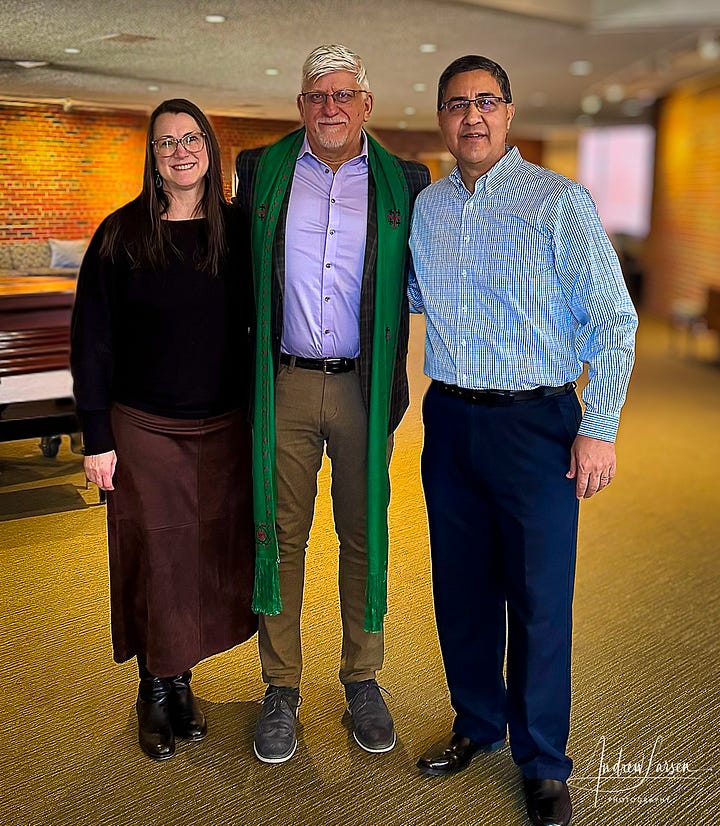
Today’s blog post is reposted with permission from Andrew Larsen and Cari Conklin-Larsen’s substack, Blessed Are the Peacemakers.It is a reflection on their visit with WCC that concluded on January 26.
Andy and Cari are in particular need of financial support to continue their ministry; subscriptions help, and individual gifts are always welcome too.
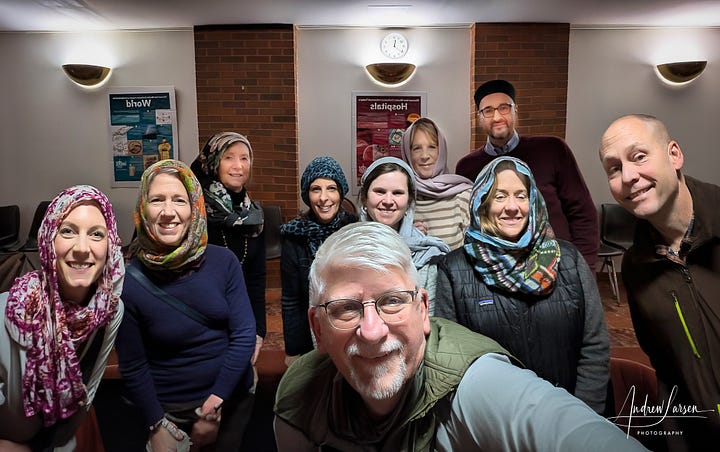
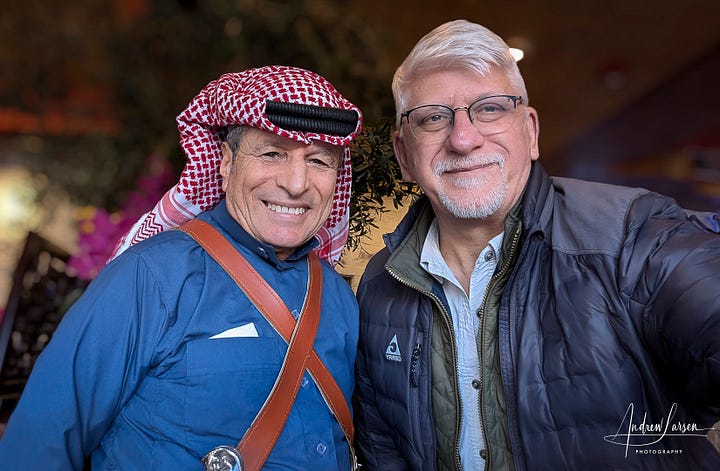
A Palestinian restaurant buzzing with conversation. An upper room in the church building, where we gathered to unpack what we’d just seen on screen. The hush of a mosque as the call to prayer echoed off the walls. A weekend filled with hospitality, hard questions, and the kind of shared laughter that carried us through every encounter. The contrast was striking, and at times, I found myself deeply grateful—not just for the warmth of our hosts but for something far less profound: the heated seats in our rental car. But that small comfort felt fleeting when I thought about those whose journeys aren’t cushioned by privilege, like Lind, a four-year-old girl killed in Gaza when her family’s car was pummeled by multiple rounds from a tank—a cruel and brutal act in the ongoing genocide. This was our weekend in Winnetka. A weekend of peacemaking. A weekend of discovering what happens when we step beyond what feels familiar and into unexpected relationships.
From Fear to Friendship: The Heart of Peacemaking
What does it take to move from fear to friendship? How do we learn to see those we’ve been conditioned to distrust as neighbors instead of enemies? What happens when we step outside our comfort zones and into unfamiliar territory? In a world that thrives on division, we believe that peacemaking is not just an idea—it’s an intentional practice of showing up, listening, and crossing boundaries.
Last weekend in Winnetka, we gathered with a church community that was eager to deepen their commitment to peacemaking. Their presence was steady throughout our three-day journey—showing up for meals, engaging in difficult but necessary conversations, and bearing witness to stories they hadn’t heard before. Cari and I had the privilege of walking alongside this community as we explored what peace might look like—not just in the Middle East, but in our own neighborhoods, families, and in the interfaith and peacemaking work that calls us forward.
We opened our Bibles and wrestled with some of the heavy challenges in our world today. We talked about Gaza. And Israel. And our own theological blind spots. As one participant put it, the film “made us all raw,” creating space for honest reflection and deep engagement.
Snow Dunes and Frozen Shores: A Different Kind of Pilgrimage
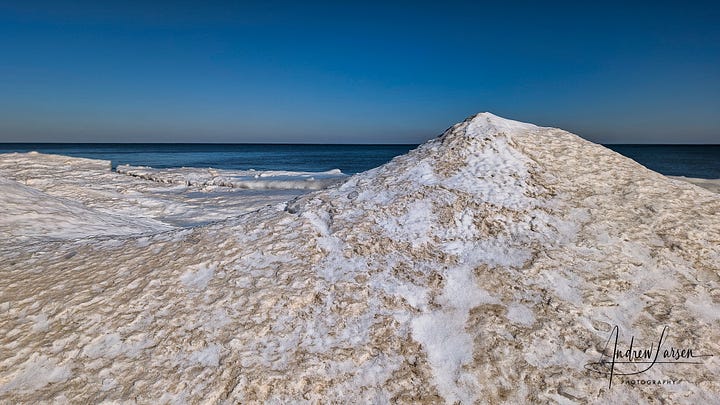
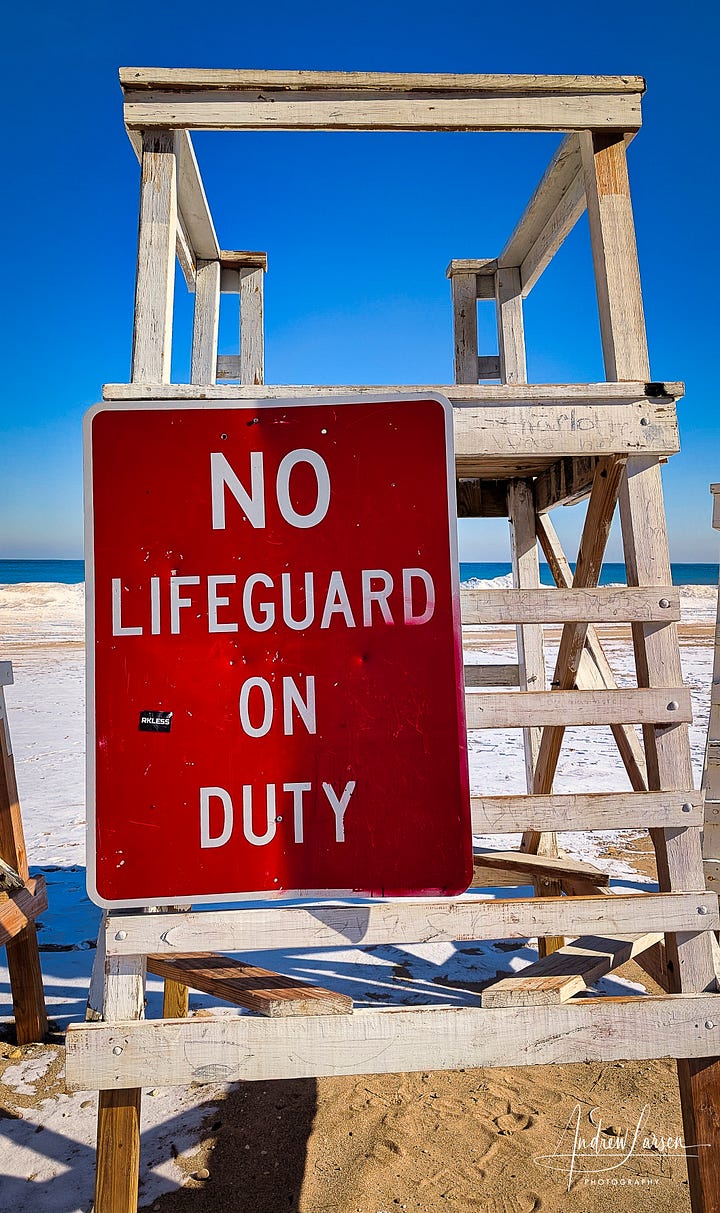
That first morning, we awoke to 4-degree temperatures and frozen ground along Lake Michigan. Our Airbnb stay in a classic Lustron home, an all-metal post-war prefab, added a quirky charm to the weekend—like living inside a time capsule from the 1950s, complete with sleek metal walls and a mid-century vibe. And outside, as we drove along Sheridan Drive near the Point Gross Lighthouse, I marveled at what I could only describe as “snow dunes”—rolling waves of white, sculpted by the wind and freezing temperatures, forming a surreal landscape where sand met ice. It was as if the very spot where sunbathers usually lounge in the summer had transformed into a frozen desert overnight—waves of snow and ice replacing the warmth of sand and sun. Not that lifeguards would have been much help—unless they had ice picks and thermal gear.
Friday: Stepping Into Sacred Spaces—Mosque Visit, Film Screening, and Raw Reflection
We kicked off the weekend with a visit to a mosque during midday prayers, where we listened to a sermon (khutbah) in Bosniac, Arabic, and English before observing the prayers of our Muslim brothers and sisters. For most in our group, it was a first-time experience, and the warmth of the Imam’s hospitality and his openness to our questions underscored how simple gestures of welcome can dissolve barriers and foster understanding. As I sat there, I also wondered—was anyone in the mosque afraid of ICE, or what the new administration might do to their community? We left feeling both grateful and inspired, having glimpsed a deeper sense of shared humanity—like Chris Martin of Coldplay sings, “and you could be my brother, not my enemy.”
“What in the world are we going to do? Look at what everybody’s going through.” — Coldplay, Everyday Life
That evening we watched Where Olive Trees Weep, a film that exposed the harsh realities of Gaza and Palestine, leaving many of us deeply moved. As the final credits rolled, the room sat in silence. Some wiped their eyes. Others stared ahead, still processing. One person finally spoke to me personally: ‘I just… I had no idea. How have we not heard these stories before?’ The weight of that realization hung in the air. That question lingered throughout the weekend, surfacing in conversations about justice, theology, and our responsibility as people of faith. The film had done what no news segment or statistic could—it had broken open hearts. Brian Madvig, a therapist and former seminary peer, helped us process the vicarious trauma we felt on Friday night. Then on Sunday, after the sermon, as we chatted in the church foyer, he reflected further, saying, “You took us to a place we should go to! It was disturbing but necessary.” His words reminded us of the vital importance of sitting with discomfort and bearing witness to truths that demand attention.
Saturday: From a Winnetka Breakfast to an Iraqi Pilgrimage—Peace Feast, Hard Questions, and Building Bridges
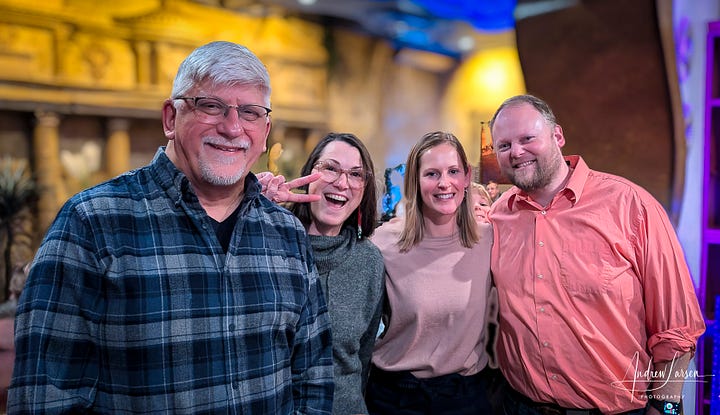
Saturday’s highlight was the Peace Feast at Al Bawadi restaurant in Niles, where over 35 people gathered to share a meal and engage in meaningful conversations. Earlier that morning, I had the chance to speak at a men’s breakfast, where I shared about my journey to Iraq and the profound experience of visiting Ayatollah Sistani with a group of Shia pilgrims. Recalling the 120-degree heat of Najaf while bracing against Chicago’s subzero temperatures was surreal. But beyond the physical contrast, something deeper struck me—how stepping into unfamiliar places, whether in the sweltering deserts of Iraq or the quiet halls of a Midwest mosque, opens up the same unexpected possibilities for connection and transformation. Over plates of hummus and grilled meats in the evening, we pondered what it means to ‘make hummus, not walls’—a phrase that echoes Banksy’s graffiti in Bethlehem and speaks to the deeper call of peacemaking.
Sunday: The Surprise That Turned to Resistance—Luke 4 and the Call to Peacemaking
On Sunday morning, I preached on Luke 4:16-21, where Jesus unrolls the scroll of Isaiah and proclaims good news to the poor, freedom for the captives, and the year of the Lord’s favor. At first, the crowd in his hometown synagogue was captivated. But then came the surprise—what Jesus chose to leave out. He stops short of the expected ending—omitting the part about the ‘day of vengeance of our God.’ By doing so, Jesus reinterprets Isaiah’s words, reframing God’s mission not as retribution but as liberation and healing for all people.
At first, they marveled at his words. But their admiration quickly turned to outrage. How could God’s mercy extend beyond their tribe? How could their exclusive hope be shared with outsiders? Their resistance built quickly, mirroring the way we, too, resist when love demands more of us than we expected—when it calls us beyond borders, beyond comfort, beyond the narratives that justify oppression. What happened that day in Nazareth still happens today.
The Bigger Picture: Peacemaking, Truth, and Discipleship
Throughout the weekend, we sought to center peacemaking as an essential part of Christian discipleship—not an add-on or extracurricular activity for specialists like me. Peacemaking is more than just reconciliation; it requires a commitment to truth—truth about our own histories, about the injustices that shape our world, and about the ‘others’ we have been conditioned to fear. Peacemaking cannot be reduced to a personal or internal pursuit alone; it must be embodied in how we engage with the world around us.
“The word peace appears 100 times in the New Testament, but theologians…often limit it to individual reconciliation with God—without significant attention to God’s work to reconcile us with others or with enemies… They often reduce it to inner peace, or peace with God, without attention to God’s will for peace among God’s creatures.” — Glenn Stassen
A Benediction and Charge for Action
At the end of my sermon, I offered this benediction and charge:
“May the Lord bless you and keep you; may the Lord make his face shine upon you and be gracious to you; may the Lord lift up his countenance upon you and give you peace.”
But I also challenged the congregation: “don’t stop there. Go out and give this blessing to someone outside your cultural, political, or religious circle. Look someone in the eye who you’ve been taught to fear, avoid, or misunderstand, and speak peace over them. Let them know that God’s face shines upon them, too. Because the kingdom of Jesus doesn’t have fences, and his love never stops at a gate.”
If God’s love knows no boundaries, then we, as followers of Jesus, should also refuse to be constrained by human-made divisions—whether cultural, political, or religious.
This wasn’t just a weekend—it was a glimpse of what’s possible. When people sit together, break bread, and share their lives, something shifts. Walls come down. Stories change us. But the work isn’t finished. Peacemaking doesn’t belong to a select few—it belongs to all of us. Where might you step in? A conversation? A shared meal? A moment of courage to cross a boundary? Because the world doesn’t just need peacekeepers or peace talkers. It needs peacemakers. Let’s keep going—together. If this work speaks to you, share it, join the conversation, and step into peacemaking wherever you are.
Join Us
We invite you to support our work in one of these ways:
Subscribe to our Substack: Stories, reflections, and resources for peacemaking.
Direct support: Partner with us through Peace Catalyst International. Learn more here.
Purchase photos and merch: Explore photography and merchandise on my website.
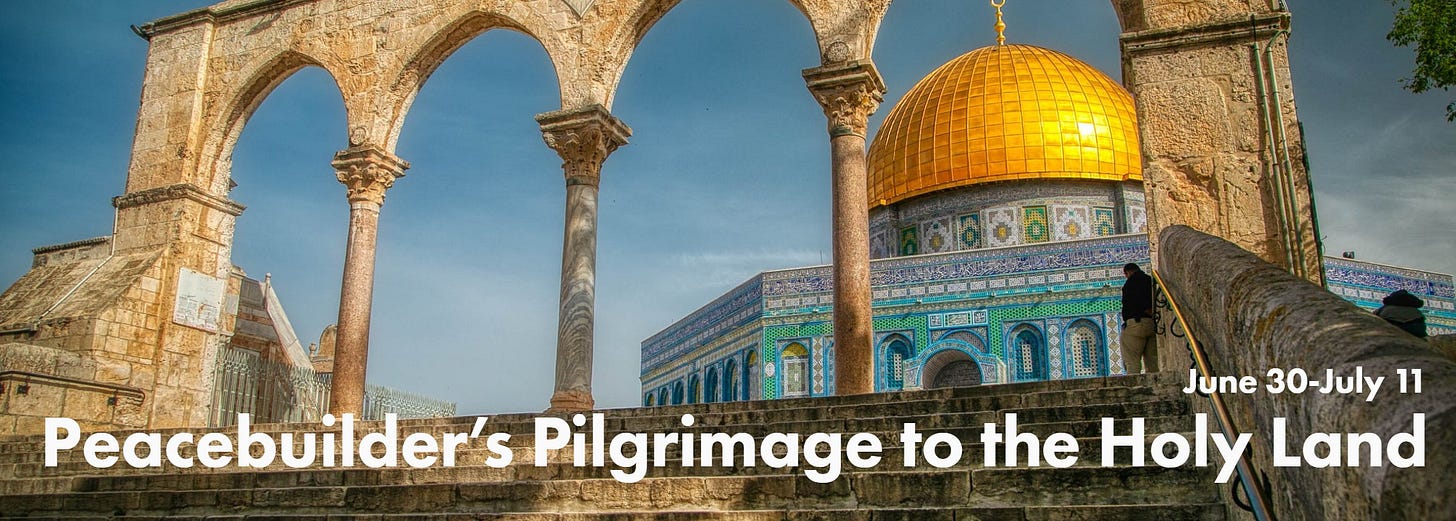
Finally, consider joining our solidarity tour to Palestine-Israel this summer. See our work firsthand and experience the heart of peacemaking: Holy Land Pilgrimage.
Peacemaking begins with proximity, courage, and love. Join us—through subscribing, supporting, or traveling—and let’s create spaces of healing, hope, and courageous love, near and far.


 Winnetka Covenant Church Blog